
Yara Peters · 22 September 2026
Leaf Morphology and Its Impact on Reverberation Times in Multi-Story Enclosed Gardens
Leaf morphology covers the physical characteristics of plant leaves such as shape, size, surface texture, vein patterns, and edge details, and these traits influence how sound waves interact with vegetation in enclosed garden environments. In multi-story structures where gardens occupy vertical spaces, sound propagation depends on absorption, reflection, and scattering that leaves provide at different frequencies. Researchers have documented these interactions through controlled measurements that track reverberation time, which represents the duration required for sound pressure to decay by 60 decibels after the source stops.
Core Elements of Leaf Morphology in Acoustic Contexts
Broad, flat leaves with waxy surfaces tend to reflect higher-frequency sounds while absorbing lower frequencies through internal damping, whereas needle-shaped or finely divided leaves create more complex scattering patterns that reduce overall reverberation across mid-range frequencies. Surface roughness from hairs, veins, or serrated edges increases frictional losses when sound waves pass over them, and this effect compounds when leaves overlap in dense canopies. Observers note that leaf orientation relative to sound paths also matters, since horizontal leaves intercept waves differently than vertically aligned ones in tall garden installations.
Reverberation Dynamics in Vertical Garden Spaces
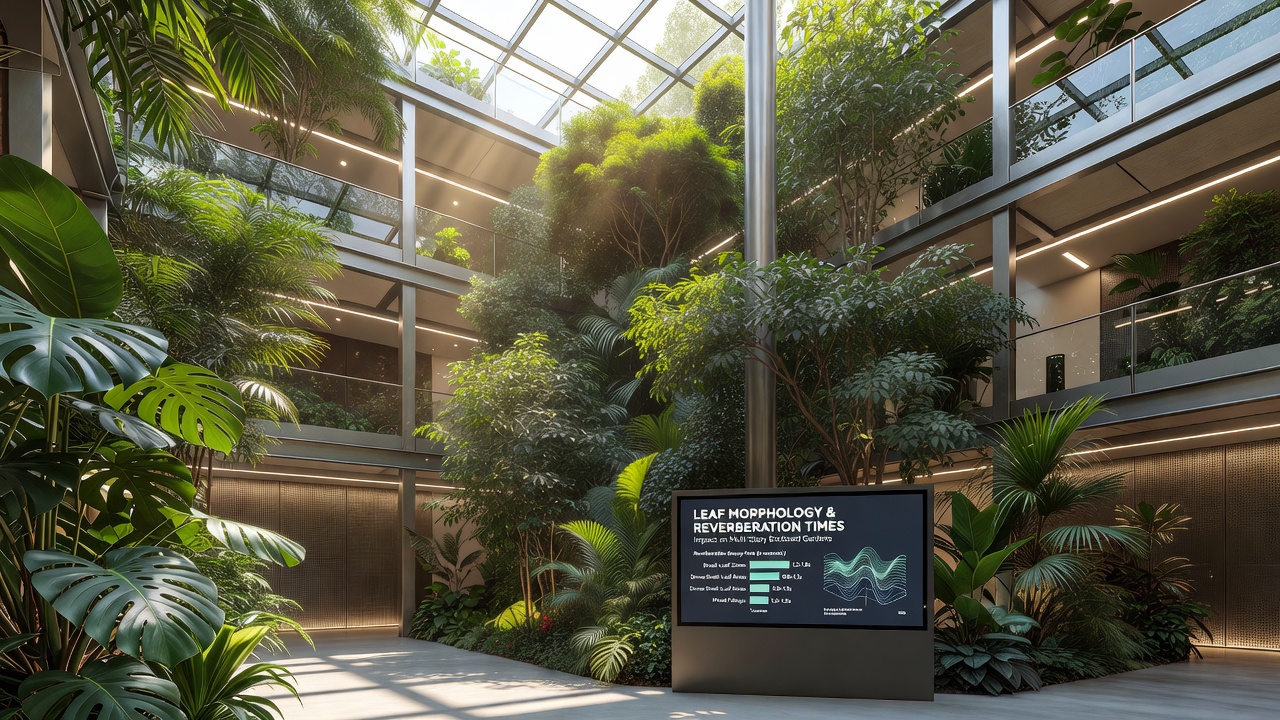
Multi-story enclosed gardens introduce layered vegetation that alters sound travel between floors, and data from acoustic modeling shows reverberation times can vary by 0.8 to 2.1 seconds depending on the dominant leaf types present. Tall atriums with minimal hard surfaces already support longer decay periods, yet the addition of plants modifies these baselines through cumulative absorption. Studies conducted in similar settings reveal that species with thick, leathery leaves contribute more to low-frequency control, while finer foliage handles speech-range frequencies more effectively.
What's interesting is how seasonal changes in leaf density further shift these patterns, especially when deciduous plants drop foliage and evergreen species remain constant. In September 2026, ongoing monitoring programs at several urban research sites will collect new datasets on these seasonal shifts to refine predictive models for building designers.
Measurement Approaches and Data Collection
Acoustic engineers employ impulse response techniques and steady-state noise methods to quantify reverberation in these gardens, placing microphones at multiple heights to capture vertical variations. Equipment records how leaf arrangements near sound sources versus distant receivers produce different decay curves, and software processes the results to isolate morphology contributions from other factors like soil beds or water features. Figures from field campaigns indicate that replacing broadleaf clusters with needle-leaf varieties can shorten reverberation times by 15 to 25 percent in the 500 Hz to 2000 Hz range.
Researchers at institutions across different regions have compared outcomes from installations in temperate and subtropical climates, and the results highlight consistent morphology-driven trends despite variations in humidity and temperature. One study from the University of Melbourne examined eucalyptus and fern combinations in a four-story test atrium, revealing that lobed leaf edges enhanced scattering at oblique angles while smooth margins promoted specular reflections back into the space.
Species Selection and Configuration Strategies
Design teams evaluate leaf morphology alongside growth habits when planning plant layouts for these gardens, since vertical stacking requires species that maintain structure without excessive shading. Data indicates that mixing morphologies across layers produces more uniform absorption than uniform plantings, and this approach reduces frequency-specific peaks in reverberation curves. Configuration details such as spacing between leaves and distance from reflective walls further modulate outcomes, with denser arrangements near hard surfaces yielding greater overall control.
According to reports from the Environmental Protection Agency, indoor acoustic performance standards increasingly reference vegetation as a supplementary treatment option in commercial and institutional buildings. Parallel work by the Acoustical Society of America continues to publish guidelines that incorporate plant-based absorption coefficients derived from morphology studies.
Conclusion
Leaf morphology directly shapes reverberation times in multi-story enclosed gardens through absorption and scattering mechanisms tied to specific physical traits. Measurement programs continue to refine understanding of these relationships across varied configurations and climates. Integration of morphology data into design processes supports more predictable acoustic outcomes in these spaces, and upcoming datasets from 2026 monitoring efforts will expand available reference values for practitioners.